


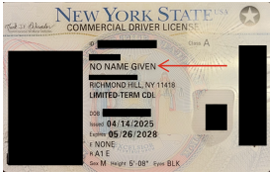
Listen up, drivers. If you’ve been scrolling through your phone at the truck stop lately, you’ve probably seen the controversy blowing up about CDLs with “NO NAME GIVEN” in the first name field. Social media went nuts. Politicians started pointing fingers. And a whole lot of good drivers got caught in the crossfire of a story that got twisted six ways from Sunday.
Let me cut through the bull and give you the straight story about what’s really going on with these licenses. Because if you’re driving with one, or if you’re a dispatcher trying to figure out whether to hire someone with one, you need the facts—not the fear-mongering.
What Sparked This Whole Mess
Back in September 2025, Oklahoma Governor Kevin Stitt posted a photo on X showing a New York CDL with “NO NAME GIVEN” in the first name slot. He claimed New York was handing out CDLs to illegal immigrants like candy at Halloween. The post got 5.7 million views and 107,000 likes faster than you can say “log violation.”
His claim? That sanctuary states were issuing licenses without proper verification, putting 80,000-pound missiles on the road driven by people with no verified identity.
Here’s what actually happened: The license was completely legitimate. It was properly issued to someone with lawful employment authorization in the United States who has what’s called a mononym—a single legal name. You know that REAL ID star in the upper right corner of the license? That proves the person provided proof of lawful status, Social Security number verification, and two proofs of residence. The individual’s actual surname was on the license but got redacted in the photo Stitt shared.
The New York DMV confirmed it straight up: “This commercial driver’s license was issued in accordance with all proper procedures, including verification of the individual’s identity through federally issued documentation.”
So What the Heck Is a Mononym?
A mononym is just a fancy word for having one legal name instead of a first name and last name. It’s not sketchy or illegal—it’s how billions of people around the world are named.
Think about it like this: You’ve got two names, right? First and last. But in many cultures—Afghanistan, Indonesia, Myanmar, parts of India, Iraq—people traditionally have just one name. It’s their legal name. Their actual name. Not a nickname, not an alias. Just one name, period.
Here’s where the confusion starts: U.S. government computer systems are built for two names. They’ve got a box for “first name” and a box for “last name.” When someone legitimately has only one name, USCIS policy says to put the single name in the “last name” field and insert “No Name Given” as a placeholder in the “first name” field.
It’s not that the person didn’t give their name. It’s that they literally don’t have a first name to give. The same exact policy applies to U.S. passports issued by the State Department. This isn’t some new sanctuary state loophole—it’s been official federal policy for years.
Let Me Make This Crystal Clear
Here are the lies versus the truth:
LIE #1: “No name given” means no identity verification.
TRUTH: These folks provided the same federal documents as everyone else—passports, employment authorization cards, you name it. They’re verified.
LIE #2: All 125 people arrested in Oklahoma had these licenses.
TRUTH: Governor Stitt’s statement mentioned encountering ONE license with “no name given.” One. Not 125.
LIE #3: The license holder was undocumented.
TRUTH: That REAL ID star proves lawful status. New York’s Green Light Law (which does allow undocumented immigrants to get standard driver’s licenses) does NOT apply to CDLs or REAL ID-compliant licenses.
LIE #4: This is some new woke policy.
TRUTH: This is how the federal government has handled single names on ALL identification documents for years.
Both Lead Stories and Snopes published fact-checks confirming these licenses are legitimate.
The Requirements Are the Same—Period
Don’t let anyone tell you drivers with mononyms skated by on some easier process. Here’s the reality:
| Requirement | Mononym CDL | Standard CDL |
|---|---|---|
| Identity verification | Required (federal documents) | Required (federal documents) |
| Social Security Number | Required | Required |
| Proof of legal presence | Required | Required |
| Knowledge tests | Required (same) | Required (same) |
| Skills tests | Required (same) | Required (same) |
| Medical certification | Required (same) | Required (same) |
| Background check | Required (same) | Required (same) |
| REAL ID compliance | Available if qualified | Available if qualified |
The only difference? One column says “NO NAME GIVEN” in the first name field, and the other has an actual first name. That’s it. Same tests. Same background checks. Same federal CDL regulations under 49 CFR Part 383.
Where Things Got Mixed Up
Now, here’s where I need to be straight with you about something important: There IS a real problem with CDL issuance that got tangled up with this mononym controversy.
Three days before Governor Stitt’s post, U.S. Transportation Secretary Sean P. Duffy announced emergency restrictions after a federal audit found over 25% of California’s non-domiciled CDLs were improperly issued. At least five fatal crashes since January 2025 involved improperly licensed drivers.
These were serious problems:
- CDLs issued with expiration dates years beyond work authorization periods
- English language proficiency not verified
- Background checks not properly conducted
- Computer programming flaws allowing improper issuances
That tragedy in August 2025 where an undocumented driver who couldn’t read highway signs killed three people in Florida? That was a real failure. States like California, Colorado, Pennsylvania, South Dakota, Texas, and Washington had legitimate procedural failures.
But here’s the thing: Mononyms have nothing to do with those problems. The federal crackdown was about improper issuance procedures, not about the routine practice of handling single names. These are two completely separate issues that got mashed together in the viral story, and now legitimate drivers are paying the price.
The Ugly: Real Problems Drivers Face
Even though these licenses are 100% legal and valid, drivers with them are catching hell out here. Let me break down the ugly reality:
Law enforcement targeting: After Oklahoma specifically called out “no name given” licenses, drivers report getting pulled over more frequently, longer detention times during stops, and assumptions they’re connected to illegal immigration—even when they’re lawful permanent residents or citizens.
Hiring headaches: Federal DOT regulations require employers to verify your employment history for the past three years. For mononym drivers, electronic systems often reject “NO NAME GIVEN” entries or fail database searches. Some carriers just won’t hire you rather than deal with the extra paperwork. That’s discrimination, but it’s happening.
DOT inspection hassles: During Level I inspections, inspectors sometimes question whether “NO NAME GIVEN” documentation is valid, flagging you for extra scrutiny and longer inspection times. You’ve got the same valid license as everyone else, but you’re getting treated like you’re suspicious.
Shipper paranoia: After a cargo theft case where the truck owner’s CDL listed “No Name Given,” some shippers started adding extra security screening. You might get rejected for high-value loads just because of your name format.
System glitches: ELD systems, insurance companies, border crossings, warehouse check-ins—half these systems aren’t set up for mononyms, causing delays and administrative nightmares.
Who Has Single Names?
This isn’t some rare thing. Single names are completely normal in cultures from:
- Afghanistan: Most Afghans traditionally have no surname. Many Afghan interpreters who helped U.S. troops and got Special Immigrant Visas have mononyms.
- Indonesia: Former Presidents Sukarno and Suharto both had single legal names.
- Myanmar (Burma): Mononyms are standard practice.
- Bhutan and Tibet: Most people use single names or combinations without family surnames.
- South India and parts of North India: Regional naming practices include single names.
- Iraq and parts of Pakistan: Similar to Afghanistan in some ethnic groups.
Given that 18.6% of U.S. truck drivers (about 224,722 of 1.2 million) are immigrants, and India is the 4th largest source country for immigrant truck drivers, mononyms in our industry aren’t uncommon. We’re talking tens of thousands of legal workers with single names keeping freight moving across America.
If You’re Driving with a Mononym CDL
First off, your license is legal. Don’t let anyone—law enforcement, a carrier, a shipper, anybody—tell you otherwise. It follows official federal USCIS policy and meets all DOT requirements.
You passed the same tests, medical certification, and background checks as every other CDL holder. You’ve got nothing to be ashamed of or apologetic about.
Here’s what you need to do:
- Document everything. Keep copies of all your identity documents, employment authorization, and any correspondence about your name. You might need to show it to employers or law enforcement.
- Know your rights. EEOC prohibits employment discrimination based on national origin, which includes name-based discrimination. If you face discrimination, document it.
- Consider legal protection. Services like TVC Pro-Driver or other CDL legal protection plans can help if you face license challenges or discrimination.
- Don’t change your name unless absolutely necessary. Some immigration attorneys suggest legal name changes at the county level, but that removes your actual name from your identity. That’s a big deal. Only do it if the administrative problems become unbearable.
If You’re a Carrier or Dispatcher
Listen, I get it. You’ve got systems that don’t play nice with “NO NAME GIVEN” entries. You’ve got to do employment verification. You’re worried about liability.
But here’s what you need to know: These are legitimate licenses. The American Trucking Associations and OOIDA both support stronger credentialing standards, but neither has said mononym licenses are a problem. Because they’re not.
Best practices:
- Accept “NO NAME GIVEN” when it appears on government-issued documents. It’s not your call to second-guess federal policy.
- Verify the license is federally compliant—check for valid authorization, REAL ID compliance if applicable.
- Use the full surname for database searches rather than getting hung up on the missing first name.
- Don’t assume immigration status based on a mononym. Many legal permanent residents and work-authorized immigrants have single names.
- Train your staff on cultural naming practices. Make it clear that discrimination won’t fly.
If your employment verification system rejects mononym entries, work around it manually. Yes, it’s a pain. But rejecting qualified drivers because of system limitations is discrimination, plain and simple.
The final mile
The viral “no name given” controversy was built on misunderstanding and got weaponized for political points. Real drivers—legal, qualified, hardworking drivers—are catching hell because people don’t understand how federal naming policy works.
Here’s what matters:
The Good: These licenses are legitimate, properly issued, and follow official federal policy. Drivers with mononyms met the same requirements as everyone else.
The Bad: The industry has no clear guidance on handling mononym applications. Major trucking associations haven’t published best practices. Carriers are left guessing, and some are taking the path of least resistance by just not hiring these drivers.
The Ugly: Legitimate drivers face increased law enforcement scrutiny, employment discrimination, and administrative nightmares—all because of widespread ignorance about what “NO NAME GIVEN” actually means.
We’ve got real CDL issuance problems to fix—the improper procedures, the lack of oversight, the tragic consequences. Let’s focus enforcement there, not on legitimate cultural naming practices that have been part of federal policy for years.
If you’re rolling with a mononym CDL, hold your head high. Your license is legal, your qualifications are solid, and anyone who tells you different is wrong.
And if you’re on the carrier side, do better. Understand the policy. Train your people. Don’t let administrative inconvenience become discrimination.
This industry runs on the backs of drivers from all over the world. Mononym or not, if you can pass the tests, handle an 80-footer in a crosswind, and deliver on time—you’re one of us.
Keep the shiny side up and the greasy side down. And don’t let ignorance slow you down.


1 Comment
Scott cobel January,18 2026
When stopped the courts have stated that Individuals must tell law Enforcement who they are, star or no star. I have enCountered several of these drivers and a lot of their so called cdl turn out to be fake and in most cases ice takes them away. As a company that ships high value m Merchandise we refuse to use these drivers