


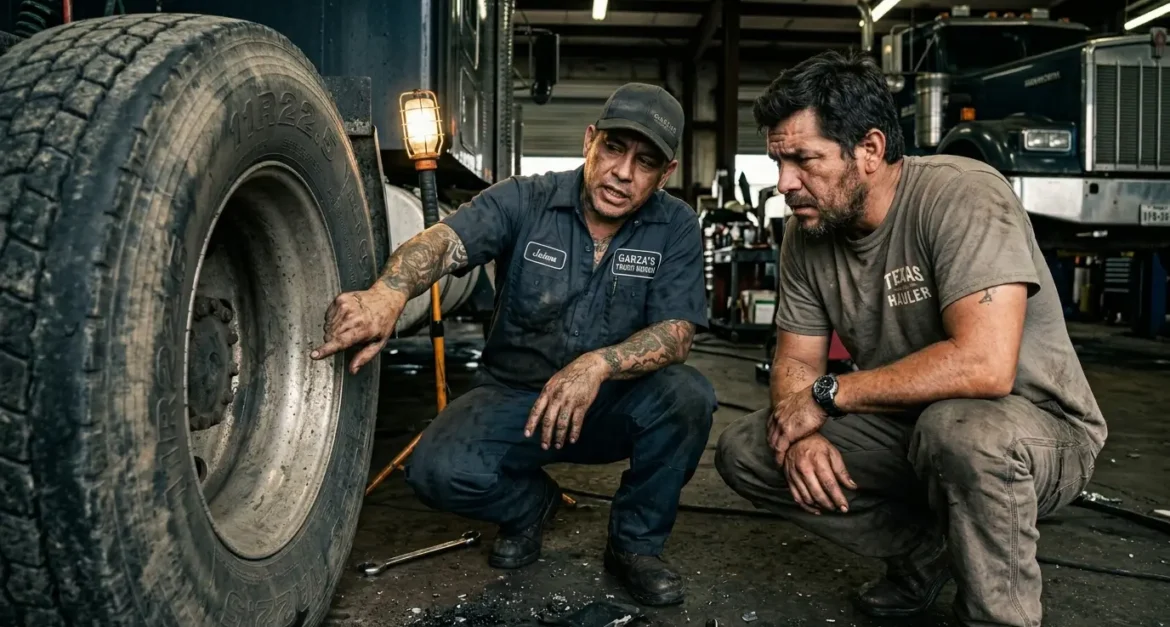
Your tire doesn’t care about your load appointment. It doesn’t care that you’re 200 miles from the yard, that the rate is finally decent, or that you’ve got a receiver screaming about an on-time window. When a tire is done, it’s done. And if you’re the one who decided to “stretch it a little longer,” you’re the one eating the roadside bill, the downtime, and the DOT headache that comes with it.
Here’s the thing: tire decisions aren’t really about rubber. They’re about risk, uptime, and cashflow. Get that framing right, and the replace-vs-retread-vs-keep-running question gets a lot easier to answer. Let’s break it down.
First, the Rules You Can’t Bend
Let’s start with the hard stops. Federal law under 49 CFR § 393.75 is crystal clear about what gets you parked on the spot. Four conditions are flat-out “remove from service now.” No exceptions, no gray area:
- Body ply or belt material exposed through the tread or sidewall
- Tread or sidewall separation
- Tire that’s flat or has an audible leak
- A cut that exposes ply or belt material
If you can see cords, if the tread is peeling away, or if air is hissing out, you are not “saving money” by rolling on. You’re pre-purchasing a much bigger problem. And during inspection blitzes, these are exactly what CVSA inspectors are looking for when they pull you over. You don’t want to be that driver.
Beyond the hard stops, federal minimum tread depth breaks down by axle position:
- Front (steer) axles: 4/32″ minimum in a major tread groove
- All other positions (drives, trailers): 2/32″ minimum
Here’s what most drivers miss: the legal minimum is not the smart minimum. Running steers down to 4/32″ to squeeze out every last mile is playing inspection roulette. A practical, experienced approach is to swap steers at 5/32″ to give yourself a compliance buffer and avoid the kind of wet-road scare that ends careers. If you want to understand exactly what inspectors are looking for before you get flagged, this DOT inspection guide for owner-operators covers it in detail.
What Actually Kills Tires (Before the Tread Runs Out)
This is where a lot of drivers get caught off guard. A tire can be perfectly legal on tread depth and still be a bad tire, because the structure fails before the rubber wears down.
The number one culprit? Underinflation. The U.S. Tire Manufacturers Association’s Truck & Bus Care manual is blunt about this: running underinflated generates excessive heat and internal structural damage that can cause tread and belt separation. Even after the tire has been reinflated. Read that again. You aired it back up, but the damage is already done. That casing might look fine today and blow apart 10,000 miles from now.
Then there’s the run-flat scenario. If you’ve had a blowout or driven on low pressure, especially at 80% or less of recommended inflation, the USTMA says that tire needs to be demounted and inspected before it goes back on the road. Not “checked with a gauge.” Demounted. Because what you can’t see from the outside can absolutely kill you on the highway.
Bridgestone identifies three main heat multipliers that shorten tire life fast: speed above the tire’s rating, overloading, and underinflation. Any one of these alone is bad. All three together? You’re not running a tire. You’re running a countdown.
And here’s something that hits the wallet directly: NACFE reports a 0.5%–1.0% increase in fuel consumption when tires run 10 psi low. That might sound small, but on a long-haul truck burning $0.48/mile in fuel, it adds up fast. On 100,000 miles, you’re looking at $240–$480 in extra fuel costs. Just from low air pressure. Combine that with the tire damage you’re causing, and the math gets ugly quick. Our breakdown of how owner-operators survive fuel costs goes deeper on these hidden expenses.
I remember talking to a driver named Devon at a Flying J outside of Laredo. Solid guy, 12 years OTR, ran his own authority. He told me he'd been nursing a drive tire for two weeks: "it's got tread, it's holding air, I'll change it in Dallas." The tire looked fine. What he didn't know was that a slow leak three weeks earlier had heat-cycled the casing into a mess inside. It let go on I-10 outside of San Antonio at 11 PM on a Tuesday. After-hours road service, a tire he had to buy on the spot, and six hours of downtime. He told me the final bill was north of $1,000. "Should've changed it in Laredo," he said. No argument there.
Real Talk from the Road
That’s the hidden tax of “I’ll stretch it.” You don’t pay with tread — you pay with time and money at the worst possible moment.
Retreads: Smart Money or Cheap Gamble?
Let’s kill the myth right here: retreads aren’t “cheap tires.” They’re asset management. You’re replacing the consumable part (tread) while keeping the expensive part (the casing). Done right, it’s one of the smartest cost moves in trucking.
And yes, they’re completely legal. FMCSA explicitly confirms that retreaded tires are permitted on commercial motor vehicles. The only exception is buses; they can’t run retreads on front axles. For trucks? Retreads on steer axles are federally legal, though most experienced owner-ops still prefer new rubber up front for peace of mind. That’s not a regulation. That’s practical risk management.
On drives and trailers, though? Retreading is where savvy operators build margin. The Tire Retread & Repair Information Bureau puts retread pricing at roughly 30–50% of a comparable new tire, a figure that lines up with what Bandag/Bridgestone quotes as well. And a quality casing can go through that process 2–3 times on average, according to USTMA’s retread report.
The catch? The casing has to be healthy. Quality retread shops use shearography (a laser imaging process) to find internal belt separations you can’t see with the naked eye. Michelin Retread Technologies runs every casing through two-step laser photography before anything gets applied. A compromised casing doesn’t get a second life. It gets scrapped. That’s the right call, not a ripoff.
The takeaway: protect your casings like the investment they are. Every underinflation episode, every run-flat, every “I’ll air it up later” moment is potentially destroying tomorrow’s retread opportunity and turning what could be a $275 retread into a $550 new tire purchase.
The CPM Math: Let’s Talk Real Numbers
ATRI’s 2024 operational cost benchmarks put tires at $0.047 per mile for the average carrier. That sounds manageable, until one bad roadside event rewrites the math entirely.
Take a look at how new vs. retread stacks up on a per-mile basis:
| Position | Federal Min. Tread | Smart Removal Target | Retread Recommendation |
|---|---|---|---|
| Steer | 4/32" | 5/32" | New tire preferred; retreads legal but uncommon |
| Drive | 2/32" | 3/32" (pull at 6/32" for retread) | Retread aggressively when casing is healthy |
| Trailer | 2/32" | 3/32" | Retread is the economic default on good casings |
Sources: 49 CFR § 393.75; TRIB retread guidance; Penske/CVSA inspection targets.
Illustrative figures based on industry benchmarks (Bandag/TRIB pricing guidance; actual mileage varies by application, routes, and maintenance).
On pure tire cost-per-mile, the retread wins if the casing is solid and you get expected mileage. That “if” is doing a lot of work in that sentence, which is why casing preservation is the whole game.
Now here’s the gut-punch scenario: one roadside blowout. Using the Continental/OOIDA emergency road service rate schedule as a benchmark, after-hours service runs $120/hour with a two-hour minimum. Add a replacement tire ($500 mid-range), plus half a day of downtime at the Fleet Maintenance benchmark of $448–$760/day, and a single incident can cost you $714 on the low end and over $1,200 on the high end. That erases the retread savings on multiple tires in one shot. Drivers on TruckersReport.com have described total road service incidents pushing $900 in real-world scenarios, and their workaround is smart: limp to a tire shop when safely possible instead of calling mobile service.
If you want to make sure your CPM calculations aren’t missing hidden costs like this, our post on the top 10 mistakes owner-operators make calculating CPM is worth 10 minutes of your time.
Position-by-Position: Where to Draw the Lines
🔴 Steer Axles: Safety First, Last, and Always
The steer position is not where you gamble. Minimum legal tread is 4/32″, but the smart move is swapping them at 5/32″ to stay well clear of violations and maintain wet-road confidence. Retreads are federally legal here, but the industry default for owner-ops is still new rubber on the front, because steer failures are disproportionately dangerous and the consequences are not recoverable. Sleep-at-night tires. Don’t overthink it. Make sure these are part of your pre-trip inspection routine every single day.
🟡 Drive Axles: Maximize Casing Value, Retread Aggressively
This is where the retread program pays off. Minimum tread is 2/32″, but pull them at 3/32″ for a compliance buffer. Better yet, if you’re running a proactive retread program, TRIB’s guidance suggests pulling drives at around 6/32″ to protect the casing for retreading. That means you’re leaving tread on the table intentionally, because a healthy casing is worth more than the last 10,000 miles of wear you’d squeeze out of it.
🟢 Trailer Positions: The Retread Workhorse
Trailer tires are where retreading truly shines and makes the most economic sense. Federal minimum is 2/32″, practical target is 3/32″. Good casings go back to the retread shop. Poor casings get replaced. The goal is to never let a trailer tire surprise you at a weigh station or on the side of the road, because trailer blowouts are one of the most common roadside failures and entirely preventable with consistent pressure management and timely rotation. Our full tire maintenance guide walks through this by position in detail.
"Retread is smart money for drives and trailers. New rubber on the steer is sleep-at-night money. Know the difference and plan accordingly."
Real Talk
International Roadcheck Is Coming. Don’t Get Caught Slipping.
Worth noting if you haven’t looked at your calendar: International Roadcheck 2026 is on the horizon, and tires are consistently one of the top out-of-service violation categories year after year. Inspectors will be checking tread depth, inflation, and visible damage. All the things we’ve been talking about. If your borderline tires were already giving you a bad feeling, that blitz is exactly the wrong time to find out you were right. Use our Roadcheck prep guide to get ahead of it.
The Decision Checklist: Make It Simple
✅ Stop and Act Now If Any of These Are True
- You can see cords or belts through the tread or sidewall: replace immediately, full stop.
- There’s a separation in the tread or sidewall: off the truck, no exceptions.
- The tire is flat or audibly leaking: do not move the vehicle.
- You ran it flat or severely underinflated (at or below 80% recommended pressure): demount and inspect before reinflating.
- You’re dealing with a chronic slow leak: investigate root cause now; this is how casing damage happens quietly.
- Your steer tires are at or below 5/32″: plan the replacement before it becomes a roadside emergency.
- Your drives or trailers are at or below 3/32″: replacement window is now, not “next load.”
- Your drive tires are around 6/32″ and you run a retread program: pull them for retread evaluation to protect the casing value.
- You’re already thinking “should I call road service?” That instinct is usually right. Limp to a shop when safe; don’t let that thought become a $1,000 after-hours bill.
The Final Mile
Tires aren’t a glamorous topic. Nobody gets excited talking about tread depth and retread shearography over the CB. But this is one of those areas where owner-operators either build margin or bleed it, one bad decision at a time.
The framework is simple: steers are safety tires, drives and trailers are profit tires. Protect the casing like it’s money in the bank. Because it is. Keep your pressures tight, pull for retread at the right time, and never let “I’ll get to it after this load” become a $1,200 roadside education.
That’s the kind of discipline that separates the operators who are still running strong in year ten from the ones who burned out by year three. If you’re serious about building a tight, profitable operation, this is one of the top mistakes owner-operators make, and it’s completely avoidable.
Run smart. Keep the shiny side up. And check your pressure before you roll out.


